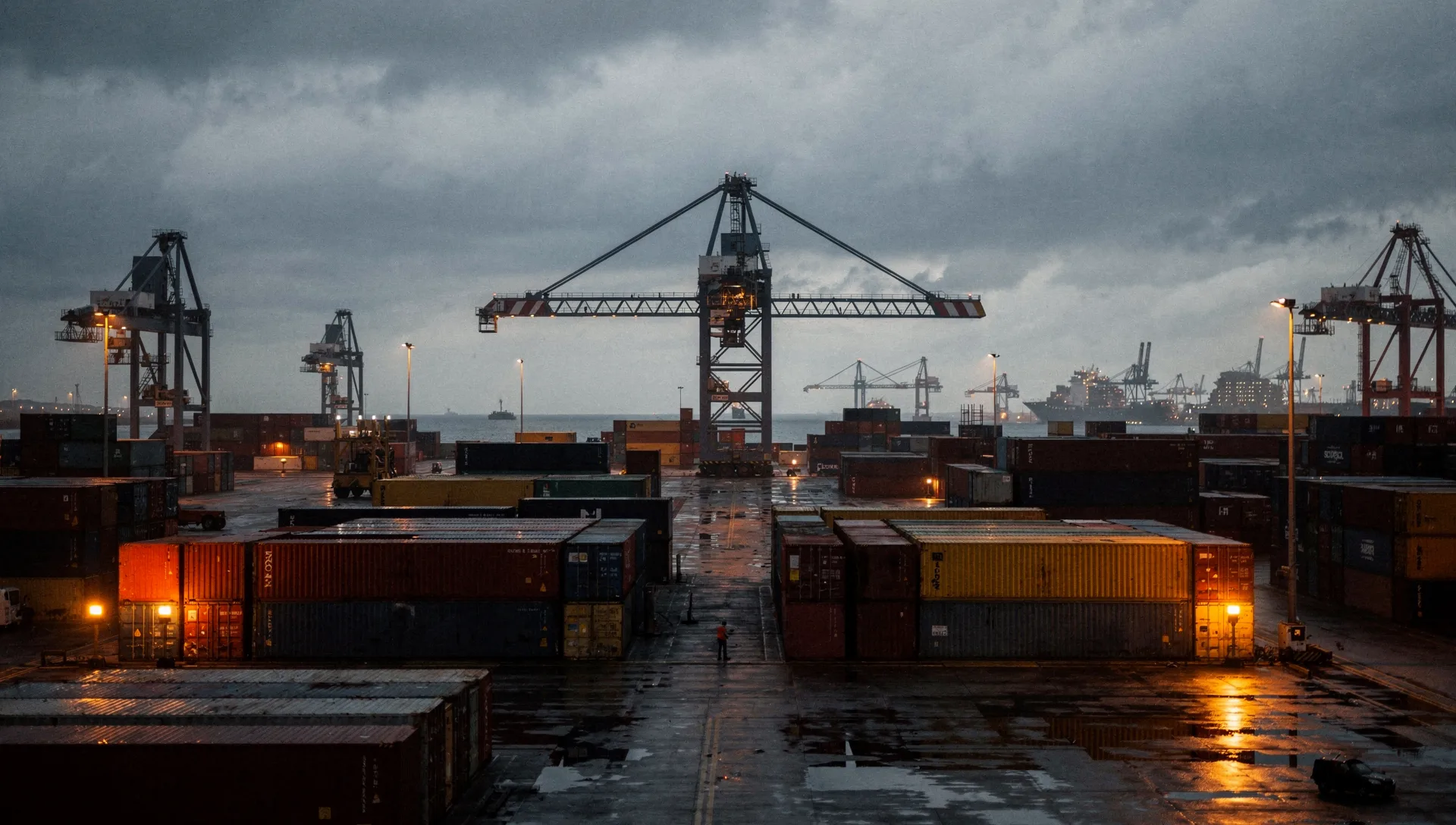

TL;DR: Fewer than one in five companies maintain a dedicated geopolitics function, yet a majority now rank political risk among their top five enterprise threats.[^1][^3] A two- or three-person team can run a workable political risk assessment using free public frameworks and a fixed watch list, without waiting for headcount that may never arrive.
Key takeaways:
- Aon's 2025 global survey of roughly 3,000 risk managers found only 14 percent actively track their exposure to their own stated top 10 risks, even as geopolitical and trade volatility entered that top 10 for the first time in the survey's 19-year history.[^2]
- A workable process needs four fixed elements: a named risk owner, a bounded watch list, a repeatable scoring method borrowed from an existing framework, and a review cadence measured in months, not years.
- Hudbay Minerals, a mid-cap Canadian miner with no political risk desk, had to shut down its Constancia mill in Peru in September 2025 after local unrest closed a transport corridor shared with two other mining companies.[^4]
- China's October 9, 2025 expansion of rare earth export controls was suspended in a truce reached three weeks later, a sequence an annual review cycle would have missed entirely.[^9][^10][^11]
- PwC's own crisis and resilience practice advises that outsourcing political risk analysis is often the more practical route for most companies, independent of whether headcount is even the constraint.[^12]
In September 2025, Hudbay Minerals shut down the mill at its Constancia copper mine in southern Peru after local unrest closed a transport corridor that Hudbay shares with MMG's Las Bambas and Glencore's Antapaccay operations.[^4][^6] Hudbay is a real, publicly traded company, not a hypothetical case study, and it does not run a geopolitical risk department. Almost no company its size does.
![A joint BCG, IMD and World Economic Forum study of more than 55 senior executives found fewer than one in five companies maintain a dedicated geopolitics or international-affairs department.[^1]](https://tfmwxtwexmnitcejfzte.supabase.co/storage/v1/object/public/field-notes-hero/b1f32673-f000-498f-b58f-40048bfc8436.webp)
The Priority Nobody Has Built a Process For
Political risk keeps climbing corporate risk-priority lists faster than companies are building anything to track it, and successive surveys keep describing the same gap in different years' language.
- Priority without ownership. WTW's 2025 Political Risk Survey found 74 percent of companies now rank political risk among their top five enterprise risks, but only 11 percent rank it their single highest priority, and 58 percent expected trade conflicts to hurt their finances in 2025.[^3] That is not disagreement about the risk. It reads more like a risk nobody has actually claimed.
- Tracking without a system. Aon's 2025 Global Risk Management Survey, covering roughly 3,000 respondents across 63 countries, found geopolitical and trade volatility entered its top 10 global business risks for the first time in the survey's 19-year run, while only 14 percent of respondents said they actively track their exposure to their own stated top 10 risks at all.[^2]
- The department gap. A joint study by BCG, IMD and the World Economic Forum, built on interviews with more than 55 senior executives, found fewer than one in five companies maintain a dedicated geopolitics or international-affairs department. Most fold the function into government affairs or corporate affairs and lean on manual curation rather than a repeatable process.[^1]
- The gap likely widens below the top tier. That BCG and WEF sample skewed toward large global companies, the ones most likely to already have some form of government affairs staff to fold the function into. There is no evidence that smaller, publicly traded mid-caps fare any better, and the honest assumption runs the other way: a company the size of Hudbay is less likely to have spare staff to reassign, not more.
![China's Ministry of Commerce expanded rare earth export controls on October 9, 2025, and suspended them in a one-year truce reached three weeks later, on October 30.[^9][^10][^11]](https://tfmwxtwexmnitcejfzte.supabase.co/storage/v1/object/public/field-notes-hero/ecbd711d-1129-41c7-934a-ffe5f049bca7.webp)
A Political Risk Assessment a Three-Person Team Can Run
None of this requires a research desk. It requires four things a lean team can actually maintain: a named owner, a bounded watch list, a repeatable scoring method, and a review cadence shorter than a year.
The owner does not need a new title. It needs to be one specific person, named in writing, whose job description says the watch list is theirs to update and escalate. A responsibility spread across a risk committee that meets quarterly is not a responsibility anyone holds day to day, and the Hudbay example above shows how fast a corridor can close relative to a quarterly meeting schedule.[^4]
The World Economic Forum's Global Risks Report already does the category work for free. Its 2026 edition sorts risk across one-, two- and ten-year horizons, built from a survey of more than 1,300 experts alongside an executive opinion survey spanning 116 economies.[^6] A lean team does not need to run its own survey. It needs to adopt that horizon structure and slot in its own markets and counterparties.
For scope, MIGA, the World Bank Group's political risk insurer, sorts political risk into four categories a two-person team can use as a checklist rather than inventing new ones: currency inconvertibility and transfer restriction, expropriation, war and civil disturbance, and breach of contract.[^7] Running every material market and counterparty against those four questions, at minimum once a quarter, catches most of what an annual review misses.
For the scoring method itself, structured analytic techniques built for exactly this problem already exist and cost nothing to adopt. The CIA's Center for the Study of Intelligence still hosts Richards Heuer's Psychology of Intelligence Analysis in full, including the Analysis of Competing Hypotheses technique, designed to stop an analyst from anchoring on the first plausible explanation.[^8] That failure mode is exactly what a two-person team without a research bench is most exposed to.
![MIGA, the World Bank Group's political risk insurer, sorts political risk into four categories: currency inconvertibility, expropriation, war and civil disturbance, and breach of contract.[^7]](https://tfmwxtwexmnitcejfzte.supabase.co/storage/v1/object/public/field-notes-hero/c612bc18-6648-4243-8095-503e448cab51.webp)
Where the Three-Week Sequence Breaks an Annual Review
An annual review cycle carries a real cost beyond being slow: it can miss an entire event from start to finish. On October 9, 2025, China's Ministry of Commerce issued Notice 2025 No. 61, expanding export controls on goods containing Chinese-origin rare earths, with a 0.1 percent de minimis threshold that reached foreign-made semiconductor and AI-related products far outside China's borders.1 Three weeks later, at a meeting in Busan on October 30, Presidents Trump and Xi agreed a one-year truce: China suspended the new controls, the United States dropped a threatened 100 percent tariff and halved a fentanyl-related tariff, and both sides paused retaliatory port fees, effective November 10.23 A company running an annual political risk review would have opened the year with one set of assumptions and closed it having missed the escalation and the truce alike.
This is also where the limits of doing everything in-house show up fastest. PwC's own crisis and resilience practice puts it plainly: large organizations can build geopolitical capability internally across travel risk, treasury and strategy, but outsourcing is often the more practical route for everyone else.4 Geopolitical risk does not wait for a hiring plan to clear finance. The four-part process above is the floor a lean team can hold on its own. Where it runs out of hours, buying the parts that need daily attention is the process working as intended, not a shortfall in it.
Fortius Intel note: If your company has no political risk desk, stop waiting for one to be approved. Assign one named owner, borrow WEF's horizon categories and MIGA's four-part taxonomy, and put the watch list on a recurring monthly calendar invite before the next quarter starts. That alone will outperform most large-company practice today.
This piece draws on the WEF Global Risks Report 2026 methodology, Aon's and WTW's 2025 risk surveys, MIGA's political risk taxonomy, and primary press and government sources for the Hudbay Minerals and China-U.S. trade sequence cases cited below.
Footnotes
-
Center for Security and Emerging Technology, Georgetown University, "Ministry of Commerce Notice 2025 No. 61," October 9, 2025, https://cset.georgetown.edu/publication/mofcom-notice-2025-61/ (retrieved September 4, 2026). Source for: China's October 9, 2025 expansion of rare earth-related export controls and the 0.1 percent de minimis threshold. ↩
-
The White House, "Fact Sheet: President Donald J. Trump Strikes Deal on Economic and Trade Relations with China," November 1, 2025, https://www.whitehouse.gov/fact-sheets/2025/11/fact-sheet-president-donald-j-trump-strikes-deal-on-economic-and-trade-relations-with-china/ (retrieved September 4, 2026). Source for: the terms of the one-year US-China trade truce, including suspension of the rare earth controls and tariff adjustments, effective November 10, 2025. ↩
-
Al Jazeera, "Trump and Xi reach trade deal, easing tensions in fierce US-China rivalry," October 30, 2025, https://www.aljazeera.com/economy/2025/10/30/trump-says-xi-agreed-to-one-year-trade-deal-after-amazing-talks (retrieved September 4, 2026). Source for: independent confirmation of the October 30, 2025 Busan meeting date and truce terms. ↩
-
PwC UK Crisis and Resilience / Geopolitical Risk Team, with Resilience First, "Building Geopolitical Resilience: Thriving in a Shifting World," March 2025, https://resiliencefirst.org/wp-content/uploads/2025/04/PwC-UK-Crisis-and-Resilience-Geopolitical-Risk-Team_Building-Geopolitical-Resilience_March-2025.pdf (retrieved September 4, 2026). Source for: the assessment that outsourcing geopolitical risk analysis is often more practical than building an in-house function. ↩
About the author
Shekhar Attri, Co-Founder & CTO. An Indian Army Special Forces veteran with 21 years of service and a gallantry medal, Shekhar's corporate security advisory work spans Singapore, India, the Philippines, and the UAE, alongside PhD research on machine intelligence under incomplete information.