Field Notes
Geopolitical Exposure Across Sectors: Energy, Finance, Technology, and Defence Compared

TL;DR: Energy carries the sharpest near term geostrategic risk exposure among the four sectors compared here, driven by mineral and route concentration, while financial services, technology, and defence face compliance, fragmentation, and procurement pressures on separate timelines.
Key takeaways:
- China's share of global rare earth refining fell from more than 90 percent in 2023 to 85 percent in 2025, and its April 2025 export controls threatened an estimated $6.5 trillion in downstream production worldwide.[1]
- Taiwan Semiconductor Manufacturing Company controlled close to 70 percent of the global chip foundry market in 2025, concentrating technology sector exposure in one geography.[2]
- NATO's European members and Canada raised 2025 defense spending to more than $571 billion, near a 20 percent year on year jump, ahead of a 2035 target of 5 percent of GDP.[3]
- The EU's 20th sanctions package, due by the end of February 2026, adds 43 vessels and 20 more Russian regional banks to its list, extending compliance exposure to institutions with no direct Russia presence.[4]
On January 14, 2026, the World Economic Forum published its Global Risks Report 2026 and ranked geoeconomic confrontation as the single most severe risk facing the global economy over the next two years, above armed conflict and extreme weather.[5] The finding reached every sector at once, but not through the same channel. Energy companies absorbed a resource and route shock, financial institutions absorbed a compliance shock, and technology and defence firms absorbed a policy fragmentation shock, each moving on its own clock.
Geostrategic Exposure, Sector by Sector
EY-Parthenon's 2026 Geostrategic Outlook maps this unevenness directly, naming a distinct primary pressure for each of the four sectors tracked here.[6] None of the four is exposed the same way, and none of them is exposed on the same schedule.
- Energy and industrials face the most direct exposure. The outlook describes operations and pricing challenged together by "critical minerals scarcity, trade restrictions and disrupted energy routes."
- Financial services firms are adjusting to regionalized rules and state directed investment priorities, and secondary sanctions exposure keeps widening. Banks with no US presence still route dollar payments through channels Washington can reach, which pulls them into compliance risk they did not directly take on.[4]
- Technology, media, and telecommunications companies face what the outlook calls market fragmentation, driven by sovereign AI policy and cyber conflict, which raises compliance complexity without one single point of failure to manage.
- Defence and aerospace firms are working through the opposite pressure: demand growth. NATO's June 2025 Hague Summit commitment lifted European and Canadian defense spending to $571 billion in 2025, close to a 20 percent increase, with a 2035 target of 5 percent of GDP.[3]

Geostrategic Supply Chains: Where Risk Concentrates
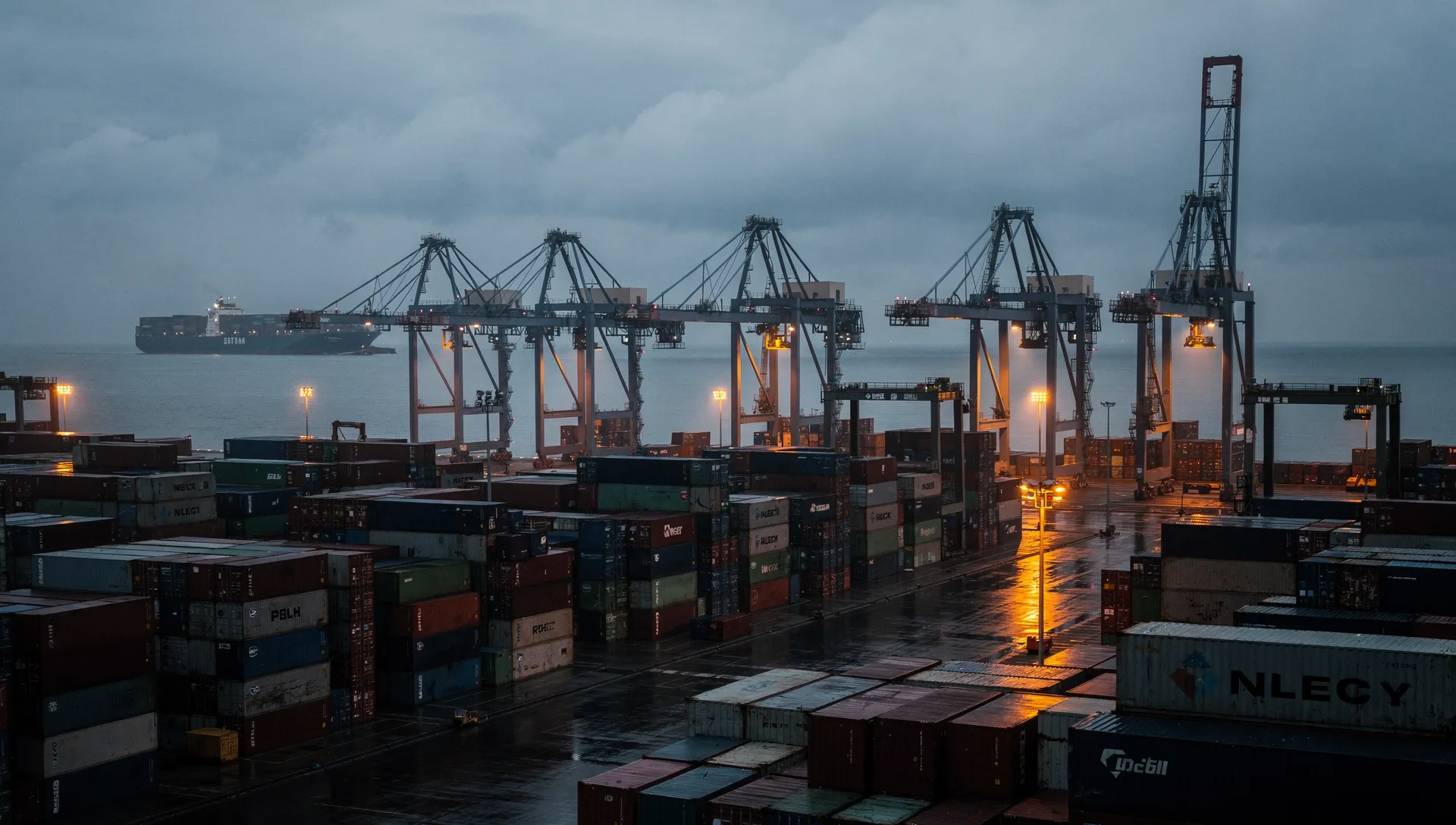
Two of these four sectors sit on the same physical chokepoints, which is why they concentrate risk harder than the other two. Energy transition hardware and advanced computing both draw on a narrow set of minerals and a narrow set of fabrication sites, and that concentration has worsened even as regulators started paying closer attention to it.
China's share of global rare earth refining slipped from more than 90 percent in 2023 to 85 percent in 2025, still dominant, and the International Energy Agency projects it will only reach roughly 70 percent by 2035.[1] When China tightened rare earth export controls in April 2025, the move threatened an estimated $6.5 trillion in annual downstream production worldwide.[1] Technology sits on a comparable chokepoint one layer up the stack: Taiwan Semiconductor Manufacturing Company alone held close to 70 percent of the global chip foundry market in 2025.[2]
Financial services and defence sit apart from that physical bottleneck. Sanctions lists and defense budgets move on political and legislative calendars, not on where a mineral deposit or a fabrication plant happens to sit. That is why a single geopolitical risk score applied across all four sectors flattens more than it reveals: a company needs a sector specific read on where the pressure is building, because the mechanism, not just the topic, determines what to watch and how often.

Geostrategic Exposure: What to Track First
The Allianz Risk Barometer 2026, also published January 14, 2026, ranked political risk and violence seventh among global business risks, its highest position on record and up from ninth in 2025. Fifty one percent of the risk managers surveyed named a geopolitical driven supply chain paralysis as the most plausible black swan event of the next five years.[7] Trade restrictions have tripled by Allianz Trade's count, now touching an estimated $2.7 trillion in merchandise, near 20 percent of global imports.[7]
At that scale, a company checking exposure once a year, or only in the sector it happens to sit in, is checking too rarely and too narrowly. A defence contractor watching NATO budget lines still needs to know if its power supplier just lost access to a mineral refiner. A bank clearing dollar payments still needs to know if a client's technology vendor got caught in an export control dispute several steps removed from banking itself. For a company building a sector risk program now, the order that holds across all four sectors is physical concentration first (minerals, fabrication sites, transit routes), sanctions and compliance calendar second, and budget or policy signal third.
Fortius Intel note: Fortius Intel publishes free geostrategic outlooks for energy, financial services, technology, and defence and aerospace at fortiusintel.com/intelligence, each built around the specific risk category named above for that sector rather than one blended score.
Methodology: this article draws on the World Economic Forum's Global Risks Report 2026, EY-Parthenon's 2026 Geostrategic Outlook, the International Energy Agency's Global Critical Minerals Outlook 2026, NATO's official defence expenditure data, Moody's Global Sanctions Landscape 2026 briefing, and the Allianz Risk Barometer 2026.
Footnotes
- International Energy Agency, "Global Critical Minerals Outlook 2026," market overview, published July 16, 2026. https://www.iea.org/reports/global-critical-minerals-outlook-2026/market-overview
- Taipei Times, "TSMC nets nearly 70% of 2025 foundry market," March 14, 2026. https://www.taipeitimes.com/News/biz/archives/2026/03/14/2003853777
- NATO, "Defence investment and NATO's 5% commitment," accessed August 2026. https://www.nato.int/en/what-we-do/introduction-to-nato/defence-expenditures-and-natos-5-commitment
- Moody's, "The global sanctions landscape 2026," accessed August 2026. https://www.moodys.com/web/en/us/kyc/resources/insights/the-global-sanctions-landscape-2026.html
- World Economic Forum, "Global Risks Report 2026: Geopolitical and economic risks rise in new age of competition," press release, January 14, 2026. https://www.weforum.org/press/2026/01/global-risks-report-2026-geopolitical-and-economic-risks-rise-in-new-age-of-competition/
- EY-Parthenon, "Geostrategic Outlook," 2026. https://www.ey.com/en_us/insights/geostrategy/geostrategic-outlook
- Allianz Commercial, "Allianz Risk Barometer 2026," January 14, 2026. https://commercial.allianz.com/news-and-insights/news/allianz-risk-barometer-2026.html
About the author
Shekhar Attri, Co-Founder & CTO. An Indian Army Special Forces veteran with 21 years of service and a gallantry medal, Shekhar's corporate security advisory work spans Singapore, India, the Philippines, and the UAE, alongside PhD research on machine intelligence under incomplete information.