Field Notes
Difference Between Country Risk and Geopolitical Risk: The Unit of Analysis Problem

TL;DR: Country risk ratings score a sovereign's fiscal and external position; geopolitical risk runs along routes, chokepoints, and counterparties that cross borders those ratings never touch. Egypt's sovereign rating improved through 2024 and 2025 even as the Suez Canal, its most exposed piece of infrastructure, lost more than half its revenue to a conflict based in a different country entirely.
Key takeaways:
- Fitch upgraded Egypt's long-term foreign-currency rating to B with a stable outlook on 2 November 2024, in the same report that flagged Suez Canal revenue as a key risk.
- Egypt lost close to $7 billion in Suez Canal revenue in 2024, a decline of more than 60 percent, according to a presidential statement citing the Suez Canal Authority chairman.
- The Suez Canal normally carries about 15 percent of global maritime trade volume, and that volume fell roughly 50 percent in the first two months of 2024 alone, per the IMF.
- S&P revised its outlook on Egypt from positive to stable in April 2025 and Fitch reaffirmed its own stable outlook, both citing debt-servicing costs rather than the canal.
- By July 2026 the IMF had disbursed $7.3 billion of Egypt's $8 billion program and said the country had weathered the fallout from the Middle East war relatively well.
A credit rating and a shipping lane can move in opposite directions without either being wrong. Fitch raised Egypt's long-term foreign-currency rating a full notch, to B, with a stable outlook, on 2 November 2024, in the same report that projected Suez Canal revenue would recover to only about half of 2023 levels by 2026.[^2] Egypt's credit story and Egypt's canal story were both true at the same time, and a country risk register built to answer the first question had almost nothing useful to say about the second.

What a Sovereign Rating Actually Scores
A sovereign credit rating answers one question: can this government service its debt and hold its currency together. Fitch's November 2024 upgrade rested on reserves, foreign investment, and a narrowing budget gap, not on whether ships kept moving through the canal that generates a meaningful share of Egypt's hard-currency income.
- Reserves, not routes. Fitch cited international reserves rising by $11.4 billion to $44.5 billion and a $24 billion investment tied to the Ras El-Hekma deal as drivers of the upgrade, alongside a declining inflation trajectory.[^2]
- The canal was a line item, not the headline. Fitch's own report projected Suez Canal revenue recovering to roughly half its FY23 level by FY26, and still rated the sovereign B stable.[^2]
- The rating held through a second review. In April 2025, S&P trimmed its outlook from positive to stable and Fitch reaffirmed stable, both pointing to debt-servicing costs and external financing needs, not the canal.[^4]
- The financing kept flowing regardless. The IMF's Extended Fund Facility for Egypt, augmented by roughly $5 billion in March 2024, had disbursed $7.3 billion of an $8 billion total by July 2026.[^5][^6]
The Geopolitical Chain a Country Score Cannot See
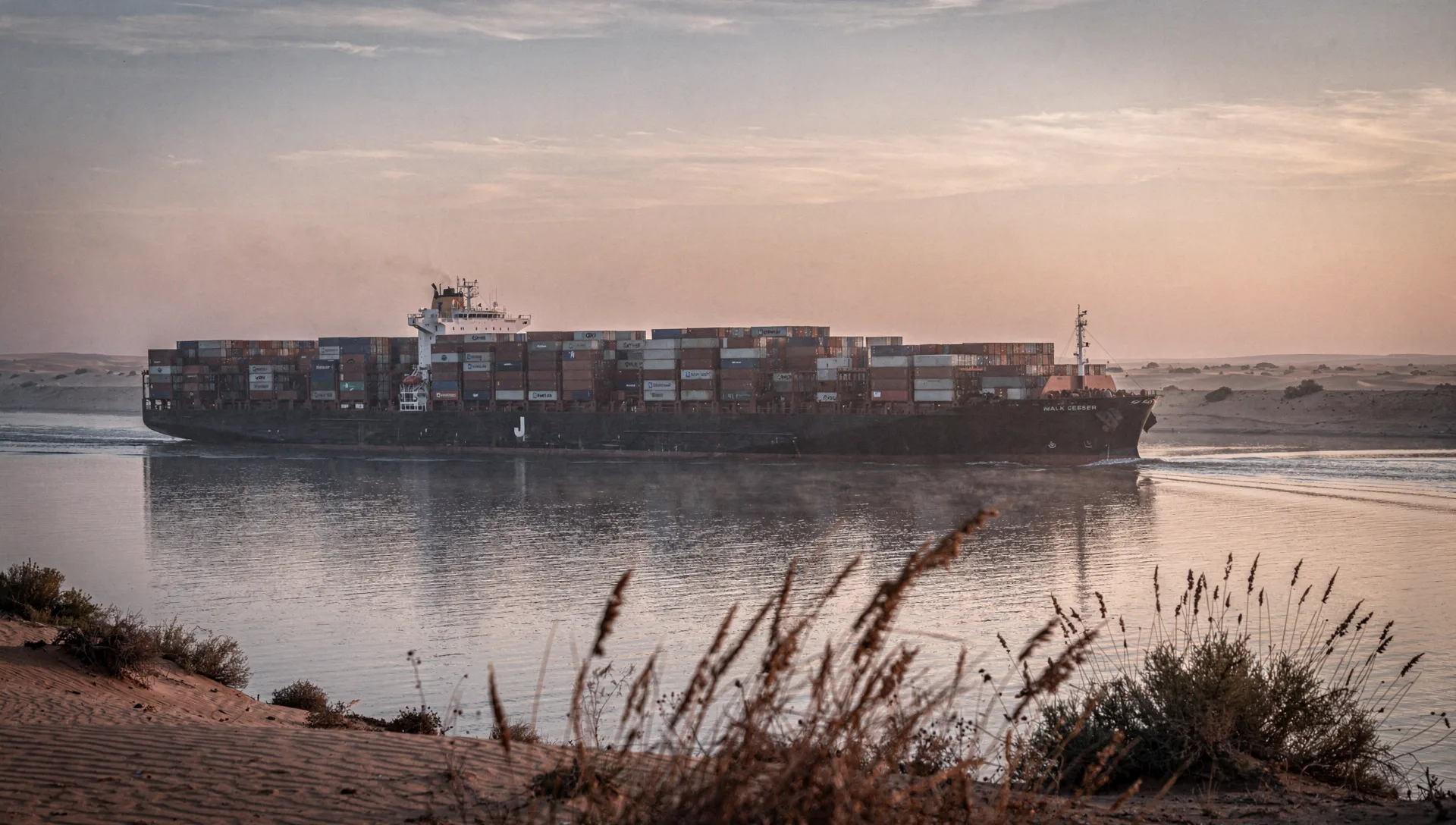
The Suez Canal is a single, non-substitutable corridor for roughly 15 percent of global maritime trade volume. When Houthi forces based in Yemen began attacking shipping in the Red Sea, canal traffic fell about 50 percent in the first two months of 2024 alone, and vessels rerouting around the Cape of Good Hope added ten days or more to each voyage.[^1] Egypt's canal revenue fell roughly $7 billion, more than 60 percent, for the year.[^3] None of that shows up in a country score for Yemen, Egypt, or any single flag state, because the risk does not sit inside one border. It sits on a corridor that a Yemen-based actor can close, that an Egypt-domiciled authority collects revenue on, and that companies headquartered in dozens of other countries depend on to move freight on schedule.
What the record shows: Egypt's sovereign fundamentals improved on the metrics rating agencies track, in the same window the canal's usable capacity fell by half. What we infer: sovereign solvency and corridor risk are different units of analysis that can move in opposite directions without either agency being wrong about its own question. What we recommend: score the corridor and the counterparty separately from the country, because a stable sovereign rating says nothing about whether the specific route a shipment depends on is open.
The same pattern held on the other side of the same disruption. The IMF reported that Panama Canal traffic fell 32 percent over the same two-month window in early 2024, driven by drought rather than conflict, yet Panama's own sovereign story ran on an entirely separate track from its canal's.[^1] Two chokepoints, two unrelated causes, two country ratings that never had to reconcile the operational damage with the credit story, because a country rating is not built to hold both at once. A company that depends on either canal was carrying a single-corridor risk that no country desk, run at the level of Egypt or Panama alone, was ever positioned to catch.
A stable country rating is a sovereign judgment about debt and reserves. The risk running through the canal is a geopolitical risk, tied to a route and an actor hundreds of miles from the finance ministry, and it will keep producing false comfort for any company that mistakes the first for evidence about the second.

Running Country Risk at the Route, Not the Border
A company exposed to the Red Sea corridor does not need a better Egypt score. It needs three things a standard country risk product does not deliver: the specific chokepoints its shipments or counterparties actually pass through, the country where the disrupting actor is based, which is often not the country generating the revenue at risk, and a live read on whether financing keeps flowing to the affected sovereign regardless of the operational disruption, since that tells you whether the country will stay stable even if your shipment does not.
Egypt is the clean case because two things that should track together instead ran independently for close to two years and are still not fully reconciled. The IMF said in July 2026 that Egypt had weathered the broader Middle East war's fallout relatively well, helped in part by a gradual recovery in canal revenue.1 That is a sovereign judgment. It says nothing about whether the corridor will hold the next time a regional actor decides to test it, and a company still routing freight through the Bab el-Mandeb strait needs an answer to that question that a country risk report was never built to give.
None of this argues for dropping country risk work. A sovereign that cannot finance itself becomes a different problem fast, and Egypt's IMF program is the backstop that kept a canal-driven revenue shock from turning into a currency crisis. The point is narrower: country risk tells a company whether its counterparty's government can function, and geopolitical risk tells it whether the specific route, port, or supplier that counterparty depends on is still open. A risk register that only tracks the first question will read as calm right up until the second one closes a corridor the company never separately watched.
Fortius Intel note: Egypt's rating and its canal revenue answered two different questions in 2024, and both answers were correct. The open question for any company running a country risk model today is whether it is asking the sovereign question when it actually needs the corridor question, and whether anyone on the risk team can tell the difference before the next chokepoint closes.
This analysis draws on IMF trade and economic data, Fitch and S&P rating actions and commentary, and Egyptian and Suez Canal Authority statements as reported by Ahram Online and Enterprise, cross-checked across at least two independent sources for the Suez Canal revenue figures.
Footnotes
-
"Egypt secures $1.8bn IMF funding as economy weathers Iran war fallout," The National, 31 July 2026. https://www.thenationalnews.com/business/economy/2026/07/31/egypt-secures-18bn-imf-funding-as-economy-weathers-iran-war-fallout/. Retrieved 23 August 2026. Source for: total IMF disbursements of $7.3 billion under Egypt's expanded $8 billion program, the IMF's assessment that Egypt weathered the Middle East war's economic fallout relatively well, and the cited role of a gradual Suez Canal revenue recovery. ↩
About the author
Shekhar Attri, Co-Founder & CTO. An Indian Army Special Forces veteran with 21 years of service and a gallantry medal, Shekhar's corporate security advisory work spans Singapore, India, the Philippines, and the UAE, alongside PhD research on machine intelligence under incomplete information.