
Field Notes
Twenty-Four Months to Replace One Supplier: The Geopolitical Cost of Aerospace Qualification Time

TL;DR: Boeing paid $4.7 billion in stock, $8.3 billion including debt, to reabsorb Spirit AeroSystems in July 2024 rather than wait out an aerospace requalification cycle that runs one to three years, a cost most supplier-risk registers never price in.
Key takeaways:
- A supplier idle for 12 to 24 months triggers the same mandatory requalification as a source qualified from zero.
- GAO reported in July 2025 that DOD's procurement database still cannot show where parts are manufactured or whether suppliers are domestic or foreign.
- More than 200,000 companies supply DOD weapon systems, and GAO found in 2022 that DOD had no enterprise-wide way to measure its risk-mitigation results.
On July 1, 2024, Boeing agreed to pay $4.7 billion in stock, $8.3 billion including assumed debt, to reabsorb Spirit AeroSystems, the fuselage maker it had spun off in 2005.¹ The deal followed the January 2024 Alaska Airlines door plug blowout and a run of fastener and drilling defects that Spirit itself said would not materially affect deliveries. No second fuselage builder was standing by. Boeing bought Spirit because standing one up would have taken longer than its production schedule, its regulators, and its shareholders could tolerate.
The Geostrategic Gap in Supplier-Risk Dashboards
Most enterprise risk platforms score a supplier on three variables: how many alternates exist, where the plant sits, and whether the balance sheet looks solvent. None of those variables answer the question a chief operating officer needs answered when a supplier fails: how many months before a substitute produces an accepted part. For capital equipment, tooling, and avionics subsystems, that number is rarely calculated because it requires stacking five separate clocks that a procurement database does not track in one place.
- Technical qualification against AS9100. A new or alternate source must hold, or earn, AS9100 certification and pass a process audit specific to the part family, a cycle that industry qualification guidance puts at one to three years for full requalification even for suppliers already in a customer's approved base.²
- Customer source approval. The airframer or prime has to run its own source-approval or PPAP-equivalent review on top of the certification body's audit, independent of how fast the certifying audit itself moves.
- Tooling and fixture transfer. Dedicated jigs, dies, and gauge sets built for one supplier's floor must be duplicated or physically relocated, then re-validated, before a second source can hold the same tolerances.
- Export licensing and facility clearance. Defense-rated components carry ITAR and facility-clearance requirements that run on a State Department and DoD calendar independent of the supplier's readiness.
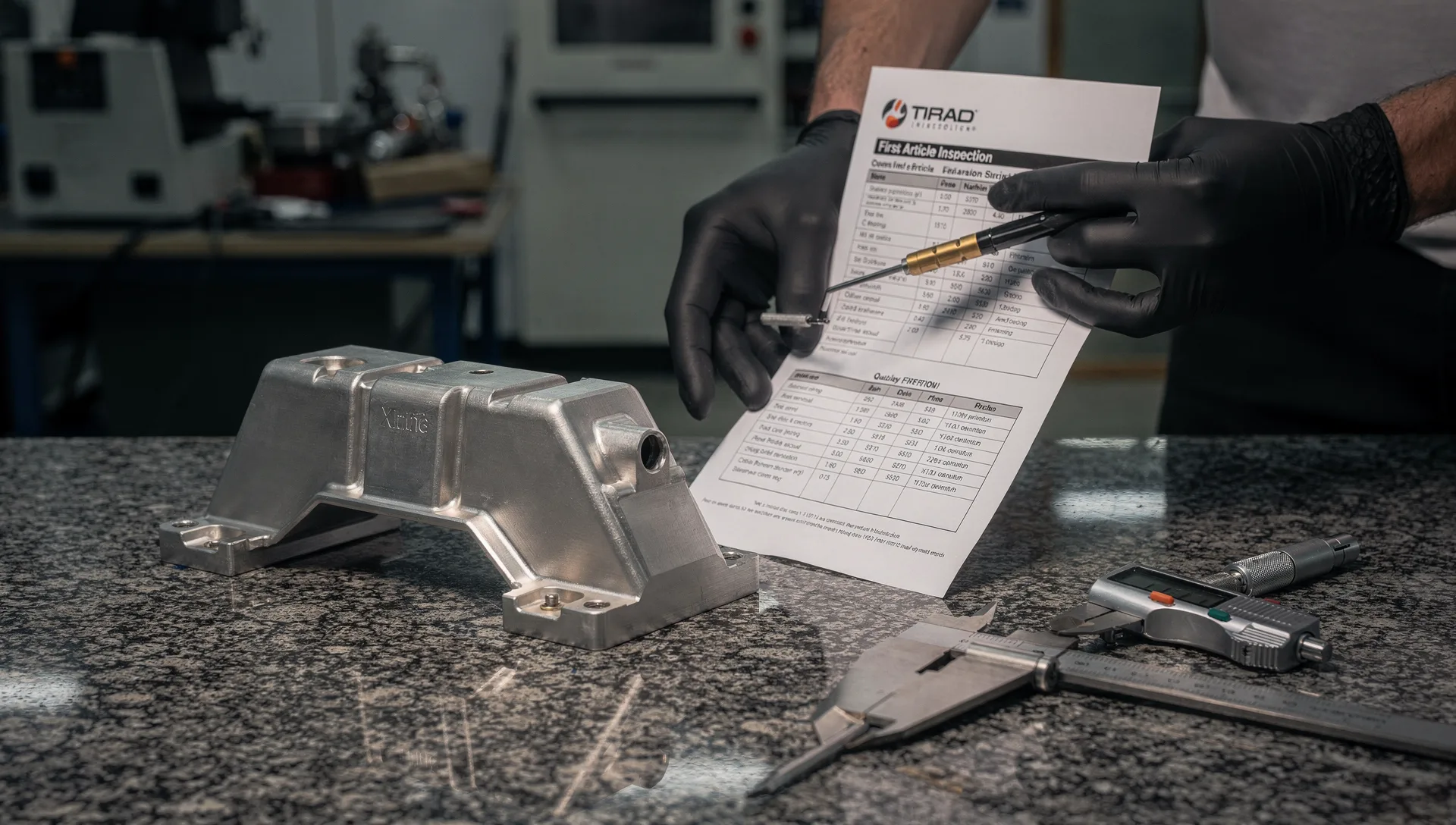
- First article inspection. Governed for defense contracts by DCMA-INST 302, first article and production lot testing has no fixed calendar deadline in the instruction itself; industry guidance puts a clean AS9102 cycle at two to six weeks, longer whenever material certifications or corrective actions require resubmission.³

The Geostrategic Arithmetic of Qualification Time
Stack those five clocks and the sum rarely resembles the single "months to requalify" figure a risk register displays. The Government Accountability Office has been documenting this measurement gap for nearly a decade. In 2017 it found that the Department of Defense's own report on single-source suppliers "did not include implementation plans and timelines for risk mitigation actions or information about the effects of the loss of suppliers," and that program officials it interviewed did not know which of their own parts came from suppliers DOD had flagged as most critical.⁴ Five years later, GAO found DOD still had no enterprise-wide performance measures to track whether its mitigation efforts for foreign and single-source dependence were working across a base of more than 200,000 companies supplying weapon systems.⁵ In July 2025, GAO reported that DOD's primary procurement database still "provides little visibility into where these goods are manufactured or whether materials and parts suppliers are domestic or foreign," a gap that keeps the department from pricing geopolitical risk into its own sourcing decisions in real time.⁶
The qualification clock does not only run during a crisis. Industry guidance on aerospace supplier management notes that a source left inactive for 12 to 24 months triggers mandatory requalification even when nothing has gone wrong, the same window a company would need to onboard a genuinely new supplier from zero.⁷ That overlap is the practical trap: a program office that treats "12 to 24 months to requalify" as an acceptable contingency plan is really describing its normal maintenance cycle, not a fallback it can compress under pressure.

The Geostrategic Stakes for Boards and Program Managers
A supplier-risk register that lists a single-source tooling vendor as "medium risk, one alternate identified" is answering the wrong question for a board deciding where to hold inventory, qualify a backup, or pay a premium for dual-sourcing. The real decision variable is whether that alternate can clear technical qualification, customer approval, tooling transfer, export licensing, and first article inspection inside the window the program can actually absorb a gap. Boeing's answer, when Spirit's quality failures collided with FAA production caps and a grounded model line, was that no alternate could close that window fast enough, so it paid to eliminate the substitution problem by owning the supplier outright.
For manufacturing, energy, and technology boards exposed to capital equipment and avionics subsystems, not every single-source relationship needs a Boeing-scale buyout. Risk committees should require program teams to state a stacked, dated time-to-substitution figure for every single-source line item above a materiality threshold, built from the same five clocks GAO has spent eight years telling DOD to track. A supplier-concentration score that treats "replaceable in theory" as equivalent to "replaceable on the timeline the business needs" is not doing its job.
Fortius Intel note: A supplier-risk score without a dated time-to-substitution figure is a geography lesson, not a mitigation plan. Boards should ask program managers for the stacked qualification clock, not the alternate-supplier count.
Methodology: Analysis draws on U.S. Government Accountability Office reports GAO-17-768 (2017), GAO-22-104154 (2022), and GAO-25-107283 (2025); NPR reporting on the Boeing-Spirit AeroSystems transaction (July 2024); DCMA Instruction 302 on First Article and Production Lot Testing; and published aerospace supplier-qualification and first-article-inspection guidance. All cited sources are publicly available.
Footnotes
1 NPR, Boeing agrees to buy Spirit AeroSystems, the supplier tied to its 737 Max production woes, July 1, 2024. Deal valued at $4.7 billion in stock, $8.3 billion including assumed debt; reintegration cited as response to quality and safety issues following the January 2024 Alaska Airlines door plug incident. Available at https://www.npr.org/2024/07/01/1249751513/boeing-buys-spirit-aerosystems-737-max-production-woes
2 QSTRAT, Best Practices for Supplier Qualification in Aerospace. States aerospace suppliers are typically requalified every one to three years, with extended inactivity of 12 to 24 months without orders triggering mandatory requalification. Available at https://qstrat.com/supplier-qualification-best-practices-aerospace/
3 U.S. Defense Contract Management Agency, DCMA-INST 302, First Article and Production Lot Testing, December 17, 2013 (validated current with administrative changes, January 12, 2015). Governs FAT/PLT surveillance and approval procedures without a fixed calendar deadline for completion. Available at https://www.dcma.mil/Portals/31/Documents/Policy/DCMA-INST-302.pdf; cycle-time estimate of two to six weeks for a clean AS9102 first article inspection from Criterion Precision, First Article Inspection for Aerospace and Defense Parts: A Complete Guide. Available at https://www.criterionprecision.com/feeds/blog/first-article-inspection-aerospace
4 U.S. Government Accountability Office, Defense Supply Chain: DOD Needs Complete Information on Single Sources of Supply to Proactively Manage the Risks, GAO-17-768, September 28, 2017. Available at https://www.gao.gov/products/gao-17-768
5 U.S. Government Accountability Office, Defense Industrial Base: DOD Should Take Actions to Strengthen Its Risk Mitigation Approach, GAO-22-104154, July 7, 2022. States more than 200,000 companies provide supplies, parts, and manufacturing for DOD weapon systems and DOD lacks enterprise-wide performance measures for mitigation efforts. Available at https://www.gao.gov/products/gao-22-104154
6 U.S. Government Accountability Office, Defense Industrial Base: Actions Needed to Address Risks Posed by Dependence on Foreign Suppliers, GAO-25-107283, July 24, 2025. Available at https://www.gao.gov/products/gao-25-107283
7 QSTRAT, Best Practices for Supplier Qualification in Aerospace. Available at https://qstrat.com/supplier-qualification-best-practices-aerospace/
About the author
Shekhar Attri, Co-Founder & CTO. An Indian Army Special Forces veteran with 21 years of service and a gallantry medal, Shekhar's corporate security advisory work spans Singapore, India, the Philippines, and the UAE, alongside PhD research on machine intelligence under incomplete information.